Let your customers shape your agents
A lot of AI agent behavior traces back to a judgment call made by the builder. Should it offer a refund right away, or ask a clarifying question first? Lead with empathy, or something more tactical?
In most cases, those are educated guesses about what your customers want. But you don't have to guess, because your agent is already having thousands of real conversations a day. The customers on the other end of them will tell you which experience works, if you let their behavior be the guide. That's what experimentation is for.
Experiments: Bringing the scientific method to agent improvement
Experiments in Agent Studio gives teams a single surface for running, reviewing, and shipping A/B tests, so every agent change you make is proven to improve your customer experience.
Measure what matters. Out of the box, every experiment is evaluated against the outcomes you care about — like resolution rate (is the agent resolving requests on its own?) and churn reduction (are your save offers retaining customers).
Ship with statistical confidence. The experiment's dashboard shows whether results are statistically significant, when the effect emerged, and whether it's stable over time — so a winning variant is a business case, not a hunch.
Manage rollouts and iterate. Ramp gradually with a small slice of traffic and increase as confidence grows. When you're ready, promote the winning variant to 100% of traffic, and it becomes the experience every customer gets.
The more you ask, the more you learn
The advantage of experimentation compounds when asking becomes cheap and you can go from "I wonder if…" to a running test in an afternoon, over and over.
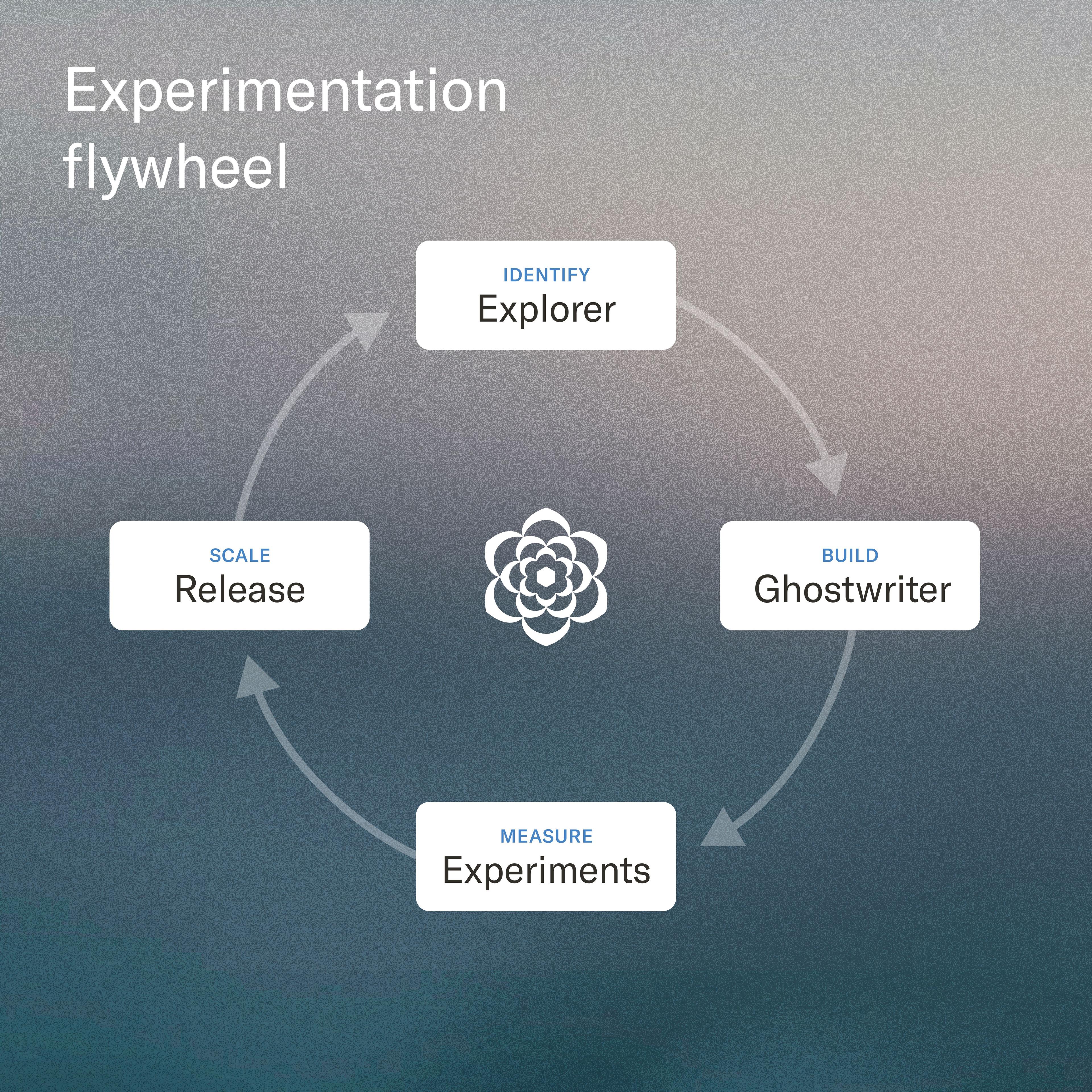
But a good experiment starts with knowing what's worth testing, and those signals live in your customer conversations. Ghostwriter analyzes every conversation for you, surfacing patterns and turning them into hypotheses to test. It then ships those hypotheses as experiments in minutes, so the gap between an idea and a live test is nearly zero. The result is that instead of running one test a quarter, you're continuously putting new ideas in front of real customers and keeping what works.

“Explorer enables us to identify the underlying drivers of customer behavior at scale, but experimentation is what allows us to establish causality. By systematically evaluating control and treatment populations, we can confidently invest in the changes that deliver measurable improvements to customer outcomes. The compounding effect has been real: month-over-month improvements in self-service rates and customer satisfaction, driving meaningful cost savings while maintaining a high-quality customer experience.”

David Cox
Head of Digital Self Service & Automation
And that learning compounds. When a variant wins, you can ask "Why did treatment A improve containment?" and get a detailed, shareable report grounded in real example conversations. That sharpens your next hypothesis, and the loop continues.
The compounding advantage
A team that ships five experiments a quarter and one that ships five a month quickly pull apart. Most tests fail, and that’s exactly why volume matters. The team running more experiments learns faster and replaces assumptions with real customer behavior.
A moment a customer interacts with your agent is a moment where trust is built or lost — but you no longer have to decide what happens in that moment by instinct. You decide what to test and what a better outcome looks like. Your customers guide the rest.