Meet Mossy: designing a voice you can see
About a decade ago, I worked at a design studio with a team of 12 people on projects that typically took one to six months to complete.
This year at Sierra I worked on a similar project: designing how to visually represent Sierra’s voice agents. This time I worked mostly on my own, using AI coding agents to explore ideas, build prototypes, and deliver the final design, Mossy. The whole process took two weeks, alongside my other projects.
With AI, a designer can explore dozens of versions of an interface in an afternoon and put one in front of real people by the end of the week.
Here’s how I brought Mossy to life, and what I learned along the way.
Start with something different
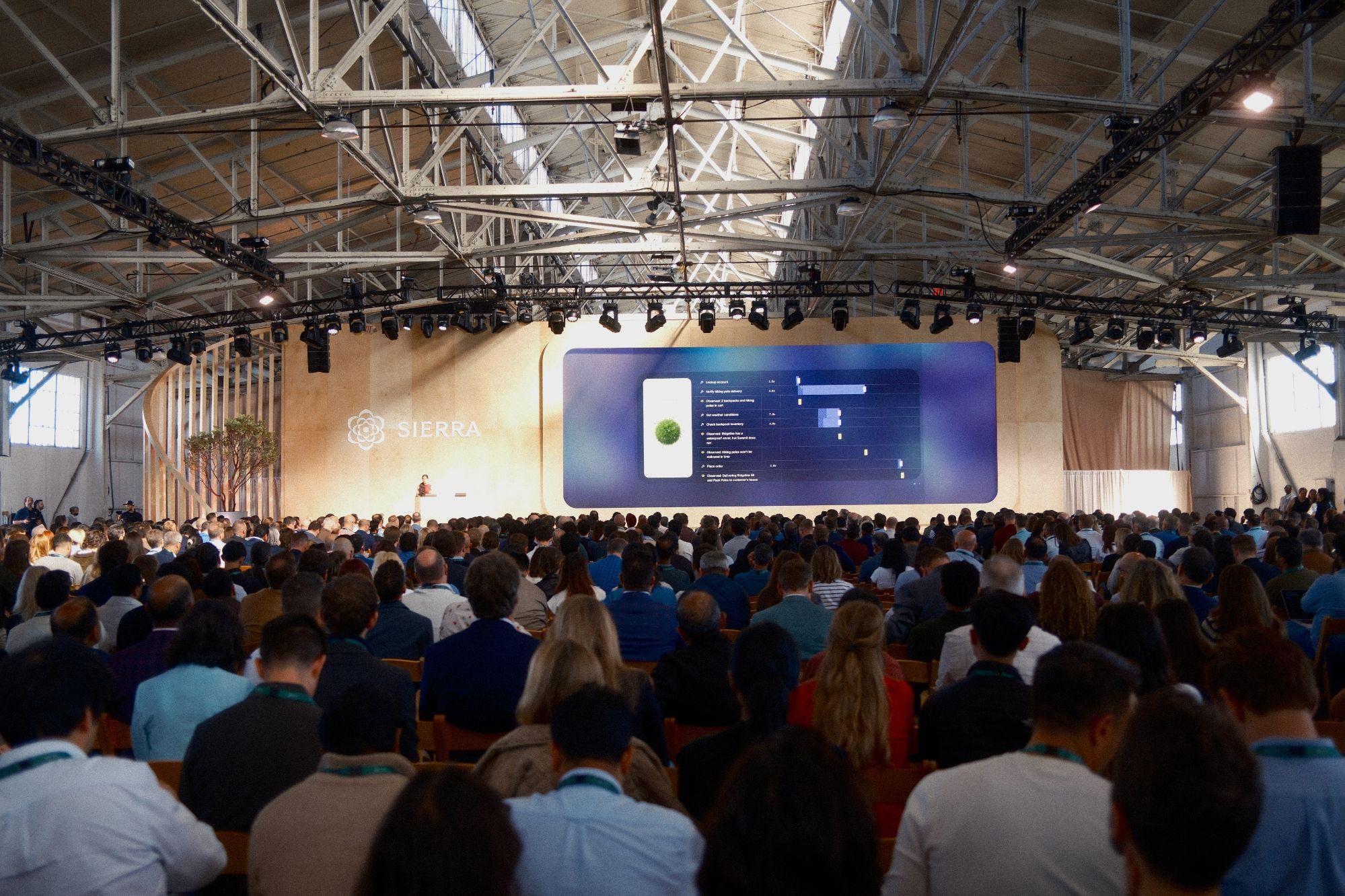
At Sierra Summit, we showcased our latest voice capabilities with Tandem Voice and Horizon agents. We wanted to show what our voice agents could do, but a voice interaction is hard to make visually interesting when so much of what’s happening is invisible. Whatever we created would appear throughout the event and needed to help people follow the conversation.

Our answer was Mossy: a living ball of grass that breathes, grows, and reacts as you speak.
Most voice interfaces are a glowing orb or a pulsing waveform. These work, but they make it hard to tell one brand from another. We wanted Mossy to look like Sierra.
Nature is a big part of Sierra’s visual identity (even our logo is a pinecone seen from above), so that’s where I started.
I tried around 50 materials, including velvet, fleece, moss, and grass, looking for one that could respond to sound. Moss came close, but its dense surface made movement too subtle. Grass had individual strands that could bend and sway with sound.
By then, we’d gotten attached to the name Mossy, so even though the material changed, the name stuck.
Build the tool, then tune by eye
Next, I built a tool that let me adjust every part of Mossy in real time: grass length, density, color, contrast, highlights, rotation, inertia, responsiveness to sound, and how far movement overshoots before settling.
AI helped me write the code quickly, which left more time for the design itself. The sliders made a big difference: instead of asking someone to make the grass “a little shorter” or the movement “a bit softer,” I could make the change and see it immediately.
I pushed each setting to its limits, from bald to fully overgrown, and kept what worked. The extremes showed me where Mossy came alive.
Look for the feedback you can act on
Early feedback was mixed: “It’s okay.” “Obsessed.” “Why does it look like a virus?” and “I can’t tell when I’m talking and when the agent is talking.”
The virus comment was fair and pointed to the grass, so I softened it and added small flowers to make Mossy look more like a plant.
The last comment was harder to fix. A voice interface has to make it clear when the agent is talking and when it’s listening. When Mossy speaks, it rotates slightly and its grass moves in different directions, almost like eyebrows following someone’s thoughts. When Mossy listens, it pulls back and gently pulses, making space for the person speaking.
Build and ship the real thing
Handoff is usually where animation work gets painful, but Mossy never lived in a Figma file or a set of After Effects specs. We worked in code from beginning to end, so the design went to production without being translated.
Two years ago, it would have been hard to imagine one designer taking a project like this from first idea to production.
Make something uniquely yours
Events like Sierra Summit are where we introduce new products and ideas. With Mossy, we also got to create a brand experience.
At a studio, core brand experiences like these usually involve 12 people deciding which variants to explore, where to invest more, and what to ship.
With Mossy, it was on me to decide what worked and when it was ready. AI makes each round faster, and the better you can iterate, the faster you end up building something great. But having more possibilities didn’t make those decisions easier — it made judgment critical.
Mossy could have been another glowing orb, but with judgment, experimentation, and a willingness to get a little strange, we ended up with something that feels like Sierra.